
Predictive maintenance in real estate with AI: Why reactive mode stays structurally expensive
In almost every hotel and multi-occupancy building, maintenance follows the same pattern: plant fails or throws an alarm — then you react. The contractor arrives, repairs or replaces, the issue is fixed. On paper that works. In practice this mode is very costly because the visible repair invoice is the smallest part of total cost.
A lift out of service in a 60-room hotel is not just mechanics: it drives complaints, awkward service flows and — if downtime drags — rating damage on Google and Booking.com. A failed air-conditioning unit in August is not only thousands in repair but potential cancellations and rebookings. A water leak feeding moisture into the structure for weeks can mean tens of thousands in remediation — while an early moisture signal might have been fixed for a few hundred pounds in seal replacement.
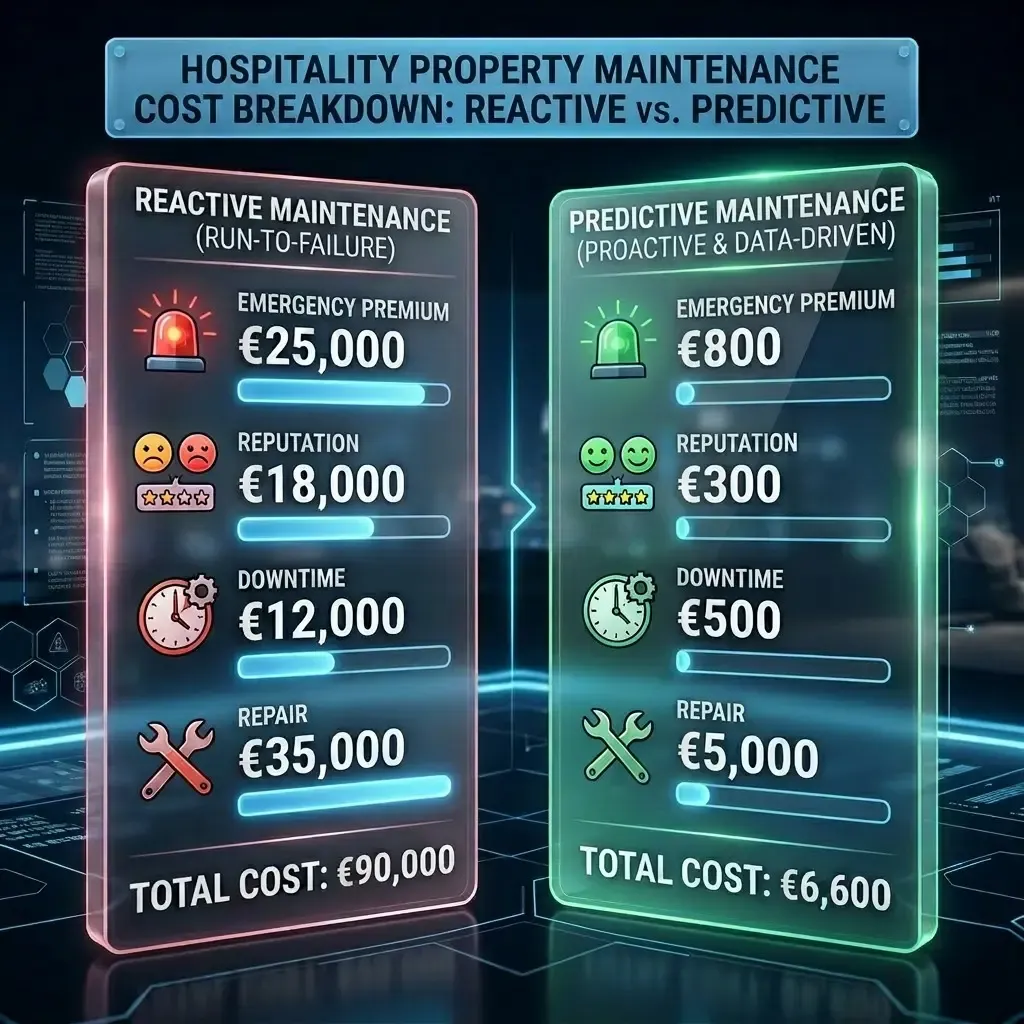
The structural issue: building services do not wear linearly. Plant typically shows a phase of subtle anomalies before failure — unusual vibration, slightly elevated running temperatures, small pressure deviations in pipework. Without continuous monitoring, people cannot see these signals. For AI systems working on sensor data they are classifiable months ahead of failure.
That is where predictive maintenance applies: not as a gimmick but as an economically evidenced way to cut total maintenance cost by roughly 25 to 40% — with higher uptime and a measurable drop in emergency call-outs.
How AI-assisted maintenance prediction works in practice
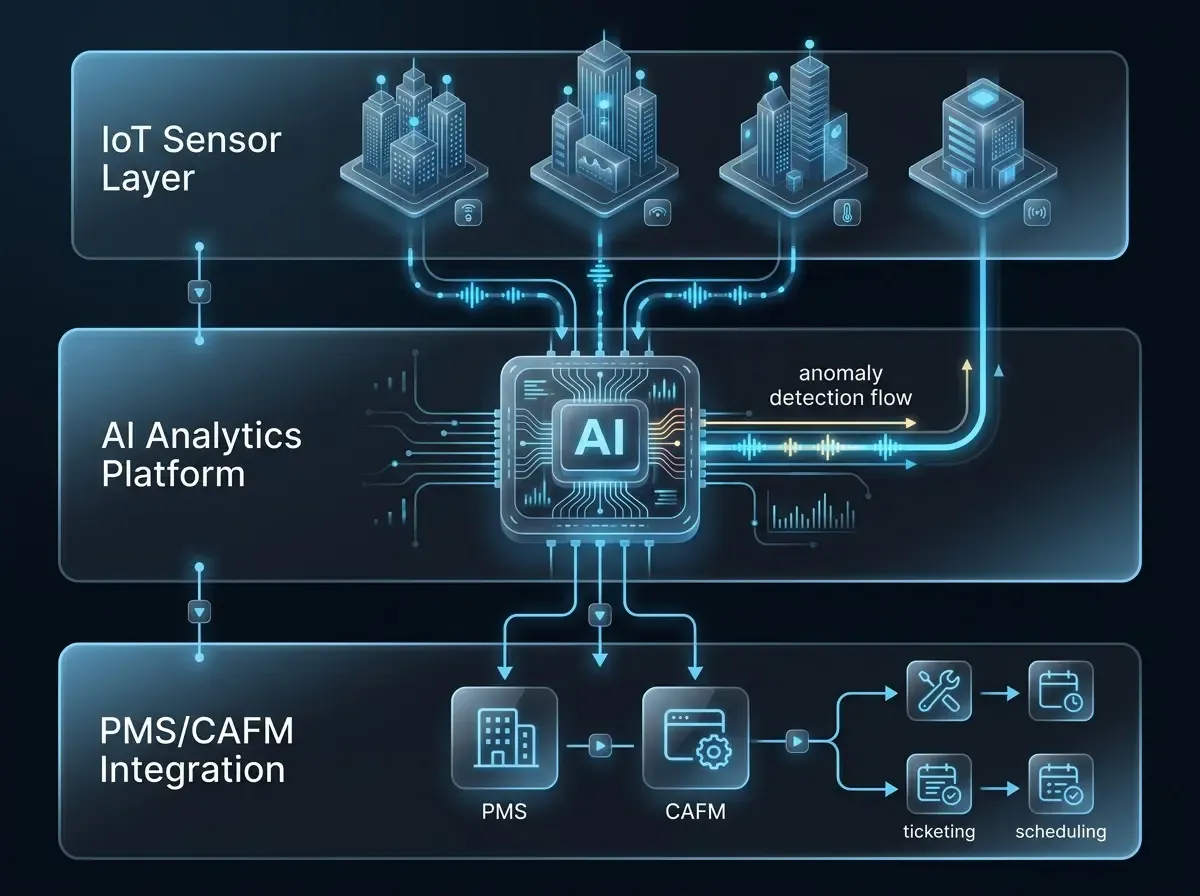
The technical foundation is more compact than many leaders assume. At core a predictive maintenance system needs three parts: sensors on relevant plant, data infrastructure that turns readings into usable time series, and an AI model that detects patterns in those series and matches them to known failure modes. What it does not need: full building automation, an enterprise-grade BMS or greenfield IT.
In practice most projects start with three to five critical plant categories: lifts, HVAC, heating, water systems and electrical distribution. These combine high failure cost with relatively simple measurable operating parameters. A temperature sensor on a chiller, a vibration sensor on a lift motor, a pressure sensor in a water line — inexpensive IoT devices whose data streams go over Wi-Fi or a simple network to a central analytics platform.
The AI model first learns each asset’s normal operating state — depending on time of day, occupancy, outdoor temperature and seasonal patterns. When readings persistently leave that learned normal band, an early warning is raised automatically. The system assigns the anomaly to a failure class, estimates remaining time to likely failure and raises a maintenance ticket in the property management system — including prioritised suggestions for maintenance planning.
Rollout in three phases: What is realistic for hospitality and property
Phase 1 — Plant audit and prioritisation: Which assets have the highest historical maintenance cost? Which failures caused the largest operational disruption in the last three years? This analysis — often distilled in days from existing maintenance logs and CAFM data — defines pilot scope. The goal is not completeness but maximum ROI in step one.
Phase 2 — Sensor rollout and data baselining: Prioritised assets are instrumented with IoT sensors. Usually four to eight weeks of data capture is enough to build a credible baseline model of normal operation. In this phase interfaces to the existing PMS or CAFM are configured so generated tickets flow straight into the operational maintenance workflow — without a parallel process.
Phase 3 — Operations, calibration and expansion: The system moves into active monitoring mode. For the first six to twelve months regular calibration matters: each maintenance intervention is fed back into the model and improves prediction accuracy iteratively. After the first season — with seasonal operating variation in the model — early-warning accuracy is typically at a level that supports credible budget planning.
The result is a maintenance strategy that gets sharper every year of operation. For asset managers and portfolio operators that means not only lower cost per asset but a new basis for investment decisions: which plant faces a major overhaul in 18 months? Which asset carries systemic maintenance risk that should affect price? Predictive maintenance is therefore not only an operational tool but a strategic asset in portfolio management.