
Why dynamic pricing in short-term rentals is now essential
Anyone running a holiday let, serviced apartment, or boutique property on fixed rates leaves money on the table twice: in peak demand you forgo yield, in weak periods a rigid rate increases vacancy risk. Dynamic pricing in short-term rentals addresses that core issue — not with speculative algorithms, but with rule-based responses to measurable market signals.
What separates operators today from professional revenue management teams is not knowing that rates should flex — it is the operational capacity to evaluate signals continuously and implement changes in time. Data-led pricing does not replace commercial judgement; it provides reliable infrastructure that compresses decision cycles from weeks to hours.
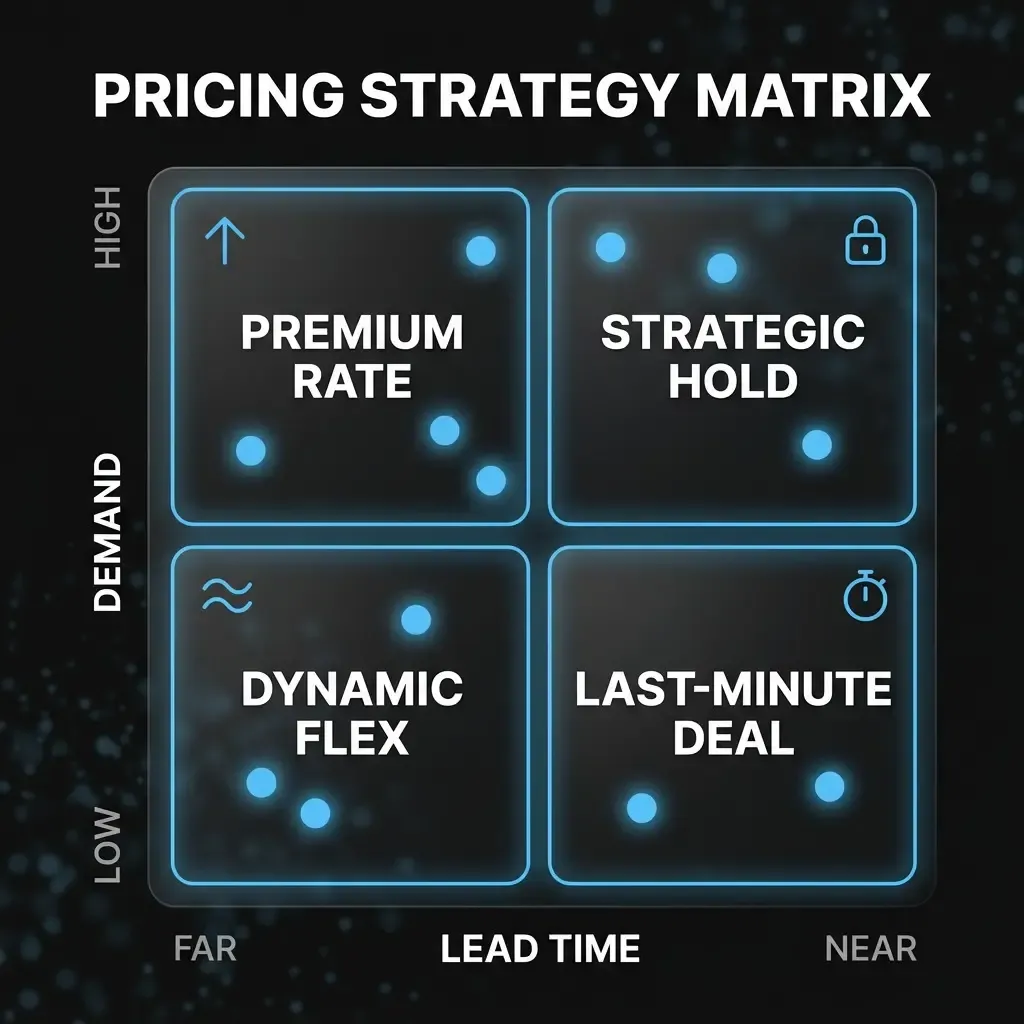
The four signal sources that actually matter
Revenue management for short-term rentals works with a manageable set of reliable inputs. The first and most important is your own booking history: how was occupancy in the same week last year? From what lead time does the portfolio typically fill? Which units book first when demand is high?
The second source is external demand signals — search volume on platforms such as Airbnb and Booking.com, local event calendars, and seasonal patterns. A city marathon, trade fair, or festival shifts demand predictably; baking those dates into the pricing model three to eight weeks ahead captures yield that static rate cards systematically miss.
The third source is competitor pricing: not as a race to undercut, but as market radar. If a comparable listing in the same segment is priced materially higher and still sells out within 48 hours, that signals demand slack your own listings can capture — often at a higher rate than you assumed.
The fourth source is your current occupancy curve: how many nights remain available in the forward window? What booking pace have you seen in the last seven days? These real-time data are the sharpest lever for short-term rate moves and can be derived directly from the channel manager or PMS.
Rules, not a black box: what credible pricing logic looks like
The most common mistake when starting dynamic pricing: buying an external revenue management tool and accepting its recommendations unchecked. Tools such as PriceLabs, Wheelhouse, or Beyond Pricing provide sensible baselines — but they do not know your property positioning or local quirks that never appear in the dataset.
Credible pricing logic starts with a manually defined rule set: a floor rate covering fixed costs plus an acceptable minimum margin; a ceiling that protects market acceptance and review scores; and a base curve reflecting seasonal patterns. Everything the tool suggests beyond that sits inside those guardrails — so it cannot generate operationally harmful race-to-the-bottom rates.
A second structural pillar is minimum-stay management. Dynamic rates optimise per night — but a portfolio that leaves two single nights open before a busy weekend loses yield through fragmentation. Minimum-stay rules that flex with neighbouring occupancy are often more impactful in practice than nudging rates by a few percentage points.
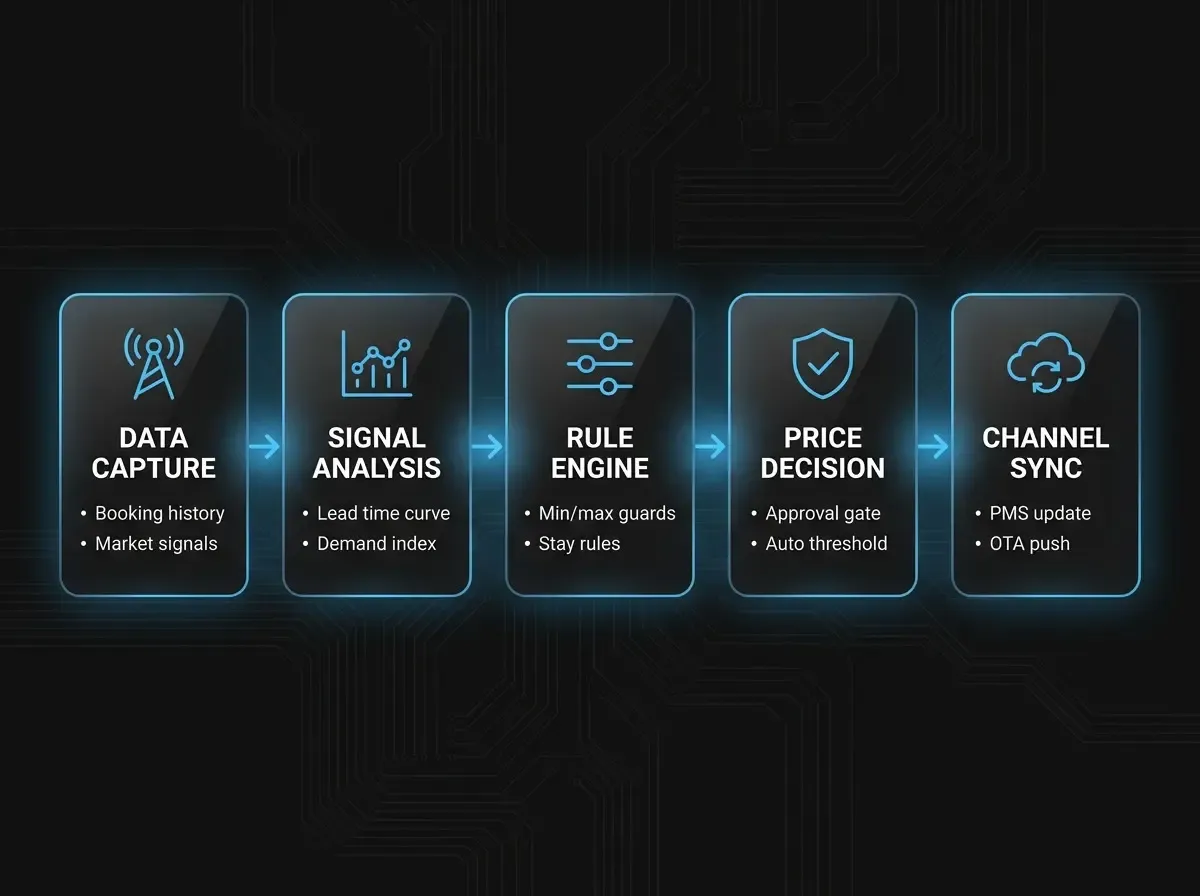
Moving to automation: phased and controlled
Fully automatic rate changes across all channels are an end state — not a sensible starting point. A phased approach protects against miscalibration that only shows up after several weeks and is then hard to unwind.
In stage one, aggregate all signals and present the operator with a daily report: recommended rate moves with rationale, deviation from the current price, and expected occupancy impact. The report makes no changes — it trains the team and validates whether the model processes the right signals.
In stage two, adjustments below a defined threshold apply automatically — for example moves under 12% in a window more than 30 days out. Changes above the threshold or inside a critical lead-time band (for example under seven days) go to approval. This hybrid logic cuts manual workload sharply without giving up control.
Only once the model’s error rate is demonstrably below a defined limit and the operator has fully internalised the rule set does broad automation make sense. For most portfolios under 30 units, the hybrid model remains the better long-term choice — because it keeps human judgement where market anomalies and local specifics are systematically underestimated.