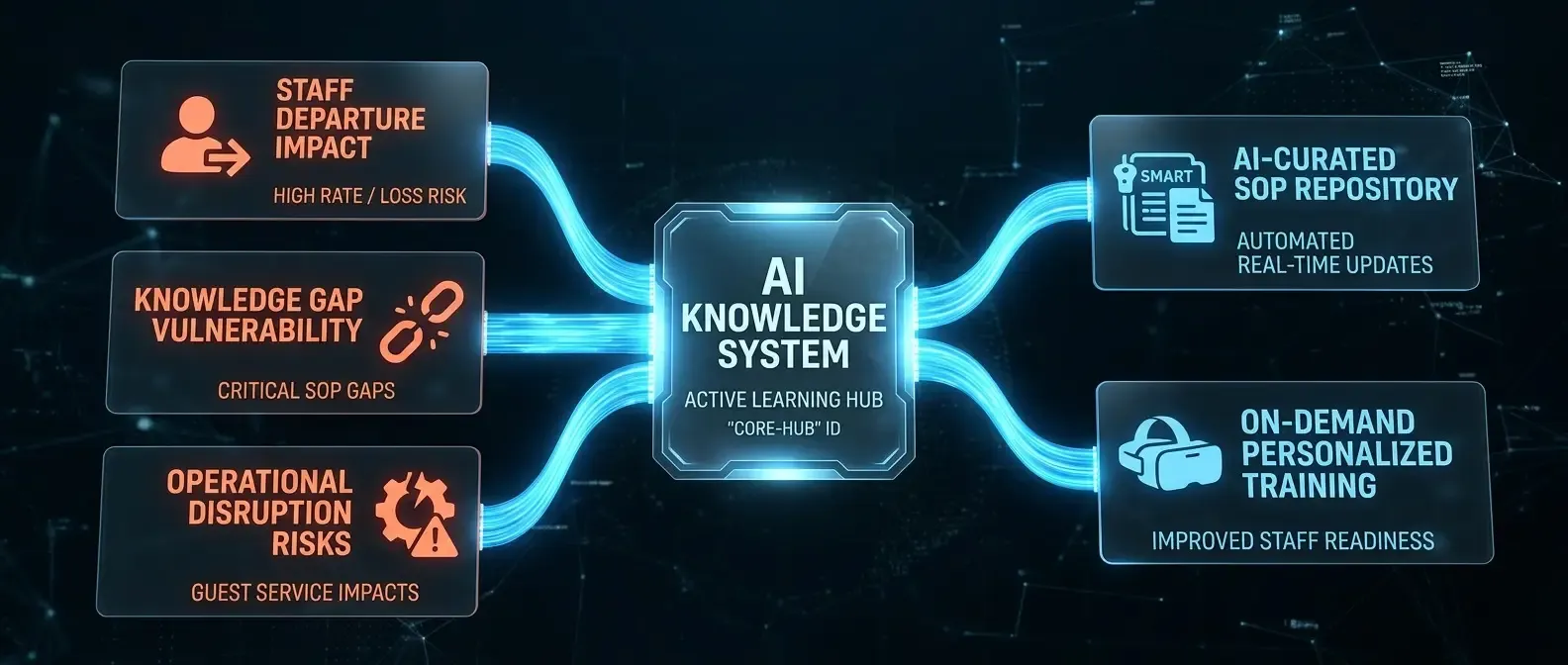
Automating AI employee onboarding in hotels: Why the status quo is costly
No other sector sees people change roles as often as hospitality and serviced apartments. Annual turnover rates of 40% to over 70% are not exceptions — they are structural. In practice, in a mid-sized operation with 30 staff, 12 to 20 people go through a full induction every year — hiring, onboarding, handover, onboarding again. Repeatedly. With the same managers. With the same documents.
The real issue is not turnover itself but that know-how experienced people carry — house rules, regular guests’ preferences, informal SOPs, PMS quirks — is nowhere reliably documented. When a receptionist leaves after two years, tacit operational knowledge walks out the door that no handover fully captures.
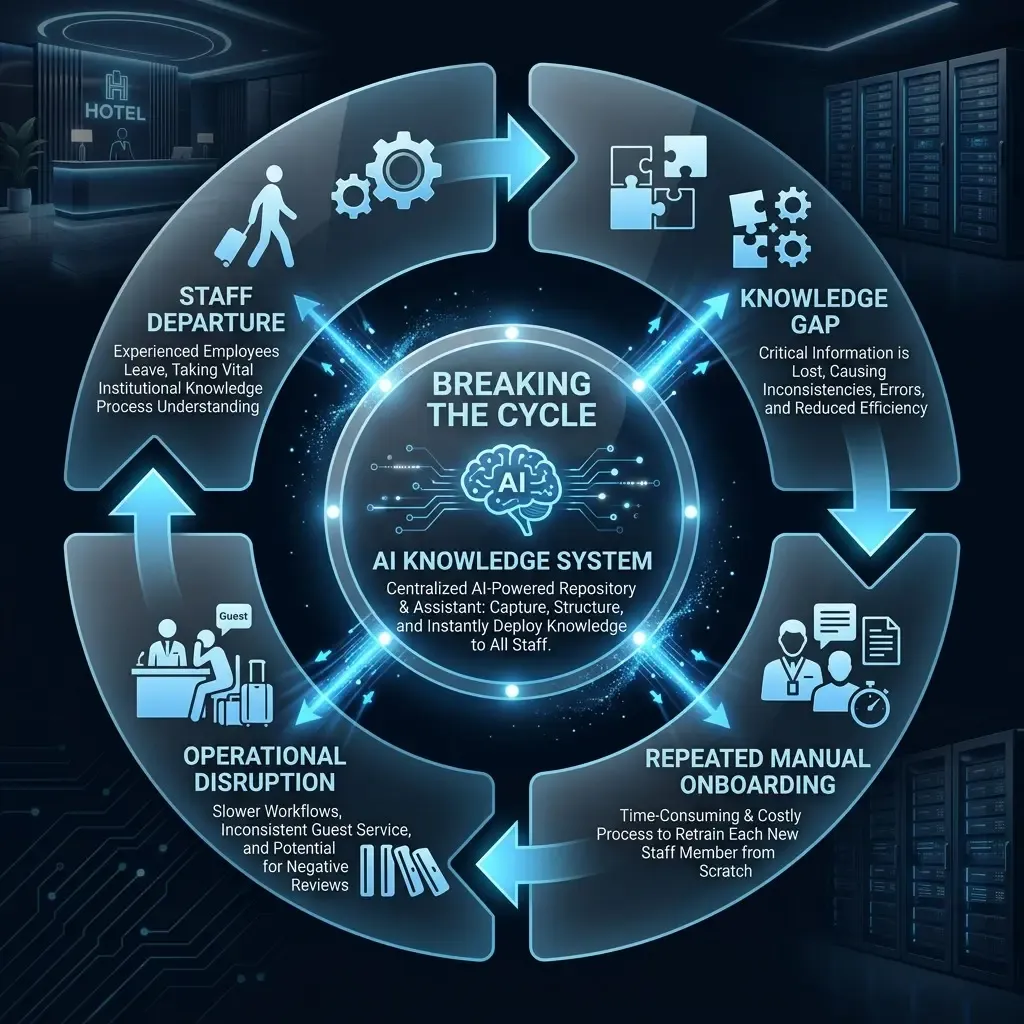
The result is a quiet service-quality gap: in the first four to eight weeks after a staffing change, response times drop, check-in errors accumulate and internal coordination effort rises. Guests notice — even when they rarely say so directly. It still shows up in ratings on Booking.com and Google.
Operators who recognise the problem often respond with thicker manuals, more checklists or longer shadowing. That does not fix the structural issue. What is needed is infrastructure that keeps knowledge actively available — whoever is on shift.
How AI-assisted knowledge management works in a hotel
The basic idea is simpler than the label suggests: existing documents — induction handbooks, SOP PDFs, shift handover emails, FAQ lists, house rules — are brought into a structured knowledge system. An AI model indexes this content and makes it available through a simple interface. New starters can ask in natural language: “How does late check-out work?” or “What happens if a guest damages the room?” — and get an answer grounded in your own operational documentation.
The system escalates to a manager automatically when a question sits outside documented knowledge — a critical safety mechanism. No new team member gets wrong answers from over-interpretation. The system also learns from escalations: recurring unanswered questions flag documentation gaps — which close with each iteration.
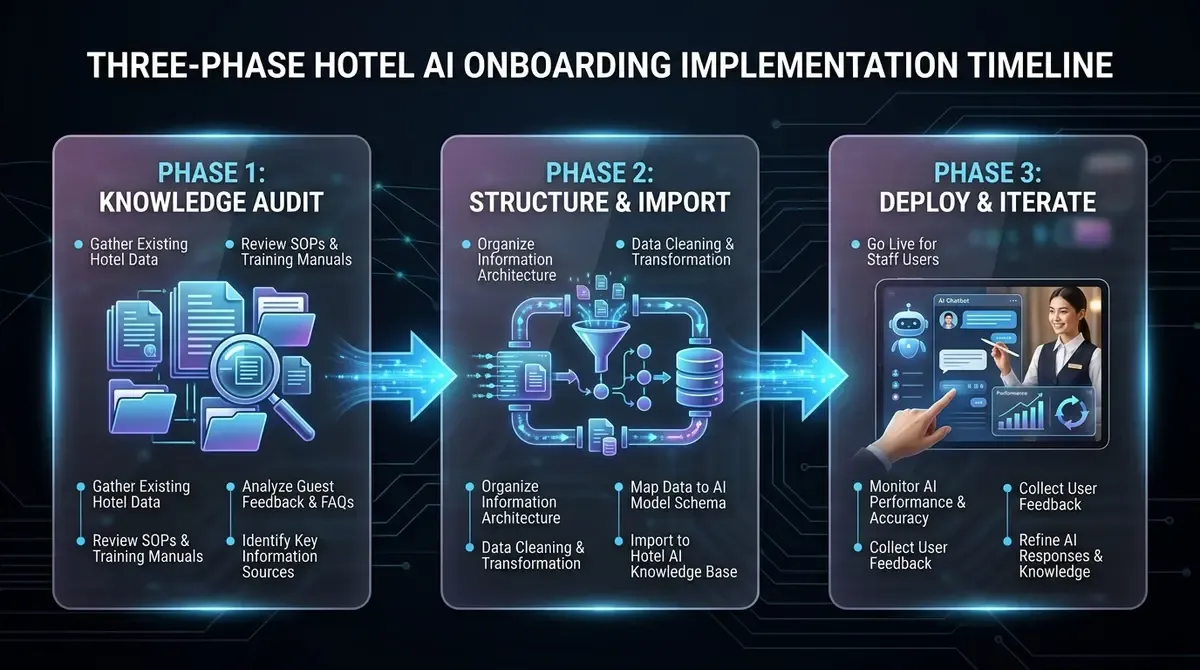
Implementation in three phases: What is realistic
Phase 1 — Knowledge audit: What documents already exist? Induction handbooks, rosters, email templates, PMS guides, internal wikis. Unstructured sources count too: WhatsApp threads with frequent questions, printed notices, spreadsheets. This phase aims for a realistic inventory — not new documents.
Phase 2 — Structuring and import: Content is categorised (guest-facing processes, internal workflows, emergencies, system guides) and imported into the knowledge system. Categorisation quality drives answer quality later. For a mid-sized operation this step usually takes two to four weeks — often with a single internal owner.
Phase 3 — Rollout and iteration: The system is introduced first as a support tool for new starters — alongside existing induction, not instead of it. After four to six weeks you have first analytics: which questions were asked often, where the system escalated, which documentation gaps appeared. Those insights feed the next documentation and tuning cycle.
The outcome is not a project with a fixed end date but a growing knowledge base that matures with the operation. Every shift change, every new season, every staffing change can add to documentation — instead of destroying know-how, the system accumulates it. For hospitality businesses with recurring seasonal staff, that is a structural advantage that compounds with every hiring cycle.