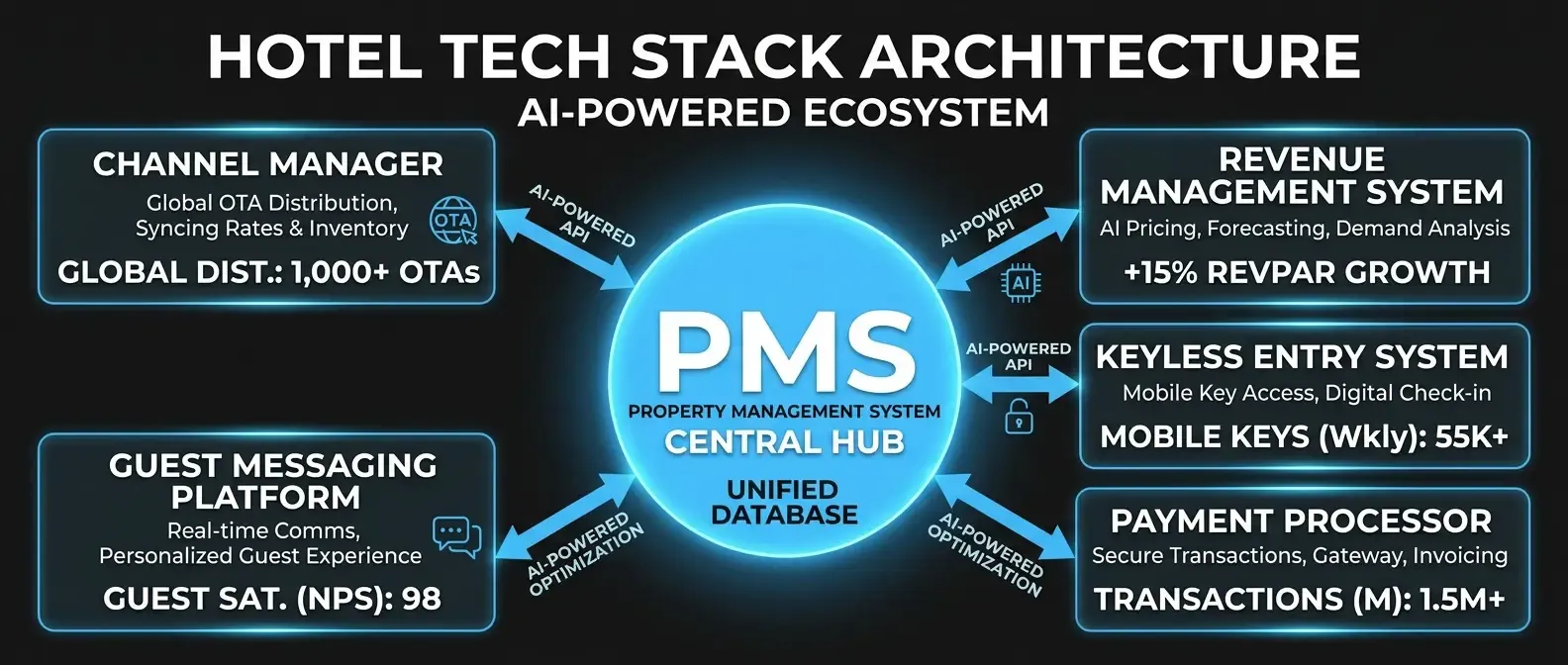
Why hotel PMS integration is a strategic problem — not a technical one
When a hotelier says their PMS is “not well integrated”, they rarely mean data cannot be moved at all. They mean transfer is unreliable: rate changes in the revenue system hit the channel manager with delay. New OTA bookings appear in the PMS only after a manual refresh. Payment data from the gateway is re-keyed into finance every evening. The plumbing works in principle — but not under real operational load.
The real cost driver is therefore not missing connectivity, but manual compensation for unreliable connectivity. In mid-sized operations, faulty or delayed transfers tie up front desk staff 30 to 90 minutes a day. For multi-property operators with five or more assets, that adds up to a full-time equivalent in data upkeep alone — a silent fixed-cost line that rarely shows up as such on the P&L.
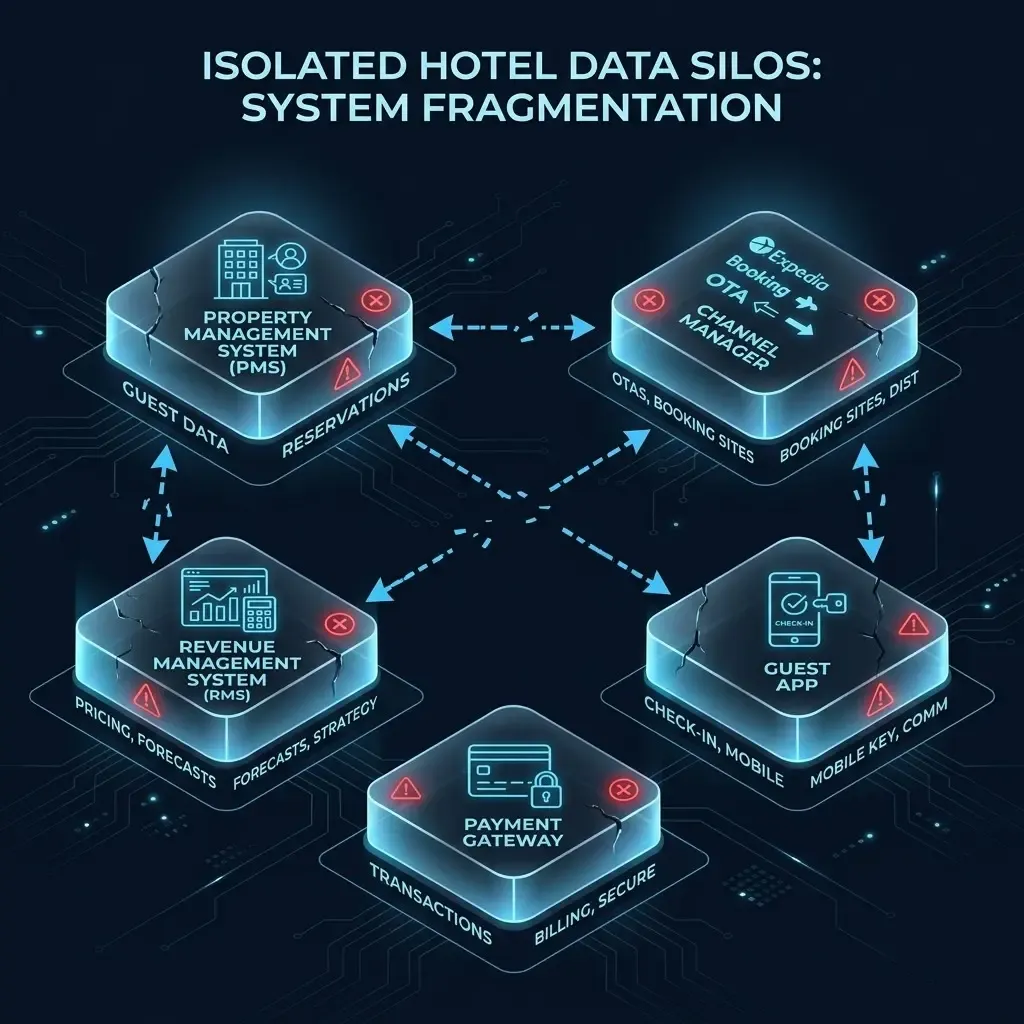
What makes it worse: hoteliers often buy new software to fix integration gaps — and create new silos. A new revenue system fixes pricing but opens a new data gap to finance. A new guest app improves communication but must be fed PMS data by hand. The stack grows without connection quality improving. That is not a procurement issue — it is an architecture issue.
The answer is not another point solution, but a layer that runs above existing systems: intelligent middleware that monitors data flows, spots inconsistencies, triggers corrections, and escalates exceptions with context — without staff having to intervene constantly.
What AI middleware actually does in the hotel tech stack
AI-assisted middleware is not another system for users to operate. It is an execution layer running in the background with three core jobs: data synchronisation, anomaly detection, and workflow triggering.
Data synchronisation: Rates, availability, and booking data are reconciled in real time between PMS and channel manager. Changes in the revenue system propagate automatically to every connected sales channel — no manual transfer, no lag. The middleware knows each connected system’s schema and translates between formats and field names.
Anomaly detection: When data states diverge — e.g. an OTA booking missing in the PMS, or a rate below the configured floor — the system flags deviation through rules and pattern recognition. Straightforward cases auto-correct. Complex cases that need judgement escalate with full context.
Workflow triggering: Certain data events kick off downstream steps. A new booking can trigger the guest welcome message, update housekeeping plans, and reserve the check-in slot for staff. That cascade runs without manual hand-offs — far more reliable than a manually coordinated chain.
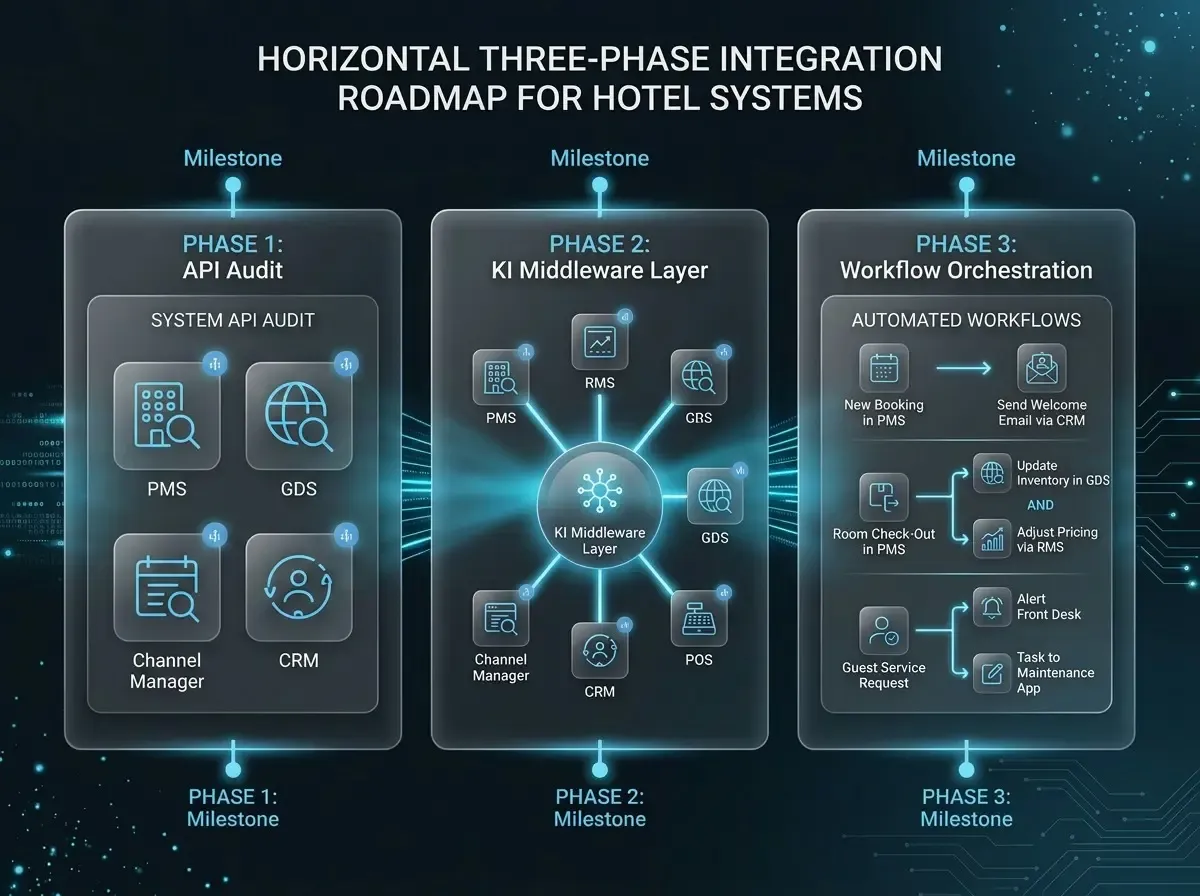
Integration in three phases: what is realistic
Phase 1 — API audit and interface inventory: Which systems are live? Which have a documented API or webhooks? Which data still moves manually because no automatic link exists? The output is an interface map: system A ↔ system B, data types, frequency, current transfer path. That grounds a prioritised integration sequence by effort and leverage.
Phase 2 — Middleware on the first system pair: Usually PMS ↔ channel manager is the right start: highest data frequency, direct revenue impact, most manual touchpoints. AI middleware is configured on that pair, transfer logic and escalation rules are set, and the stack runs in parallel for two to four weeks — manual transfer still on, middleware alongside. Divergence between the two paths is analysed and used for calibration.
Phase 3 — Extend to further systems and workflow automation: After a successful pilot, middleware expands to more pairs: revenue management, payments, housekeeping, guest app. Cascading workflows are added — event-driven chains where one data change triggers several follow-on actions. The result is not a one-off integration project but an operationally learning landscape that gets stronger with each workflow.
Hotel PMS integration with AI is not a vanity project for big chains. The largest lever sits with mid-sized operators and multi-property owners where manual workarounds for integration gaps already represent a measurable cost — and where a focused pilot can deliver credible results within weeks.